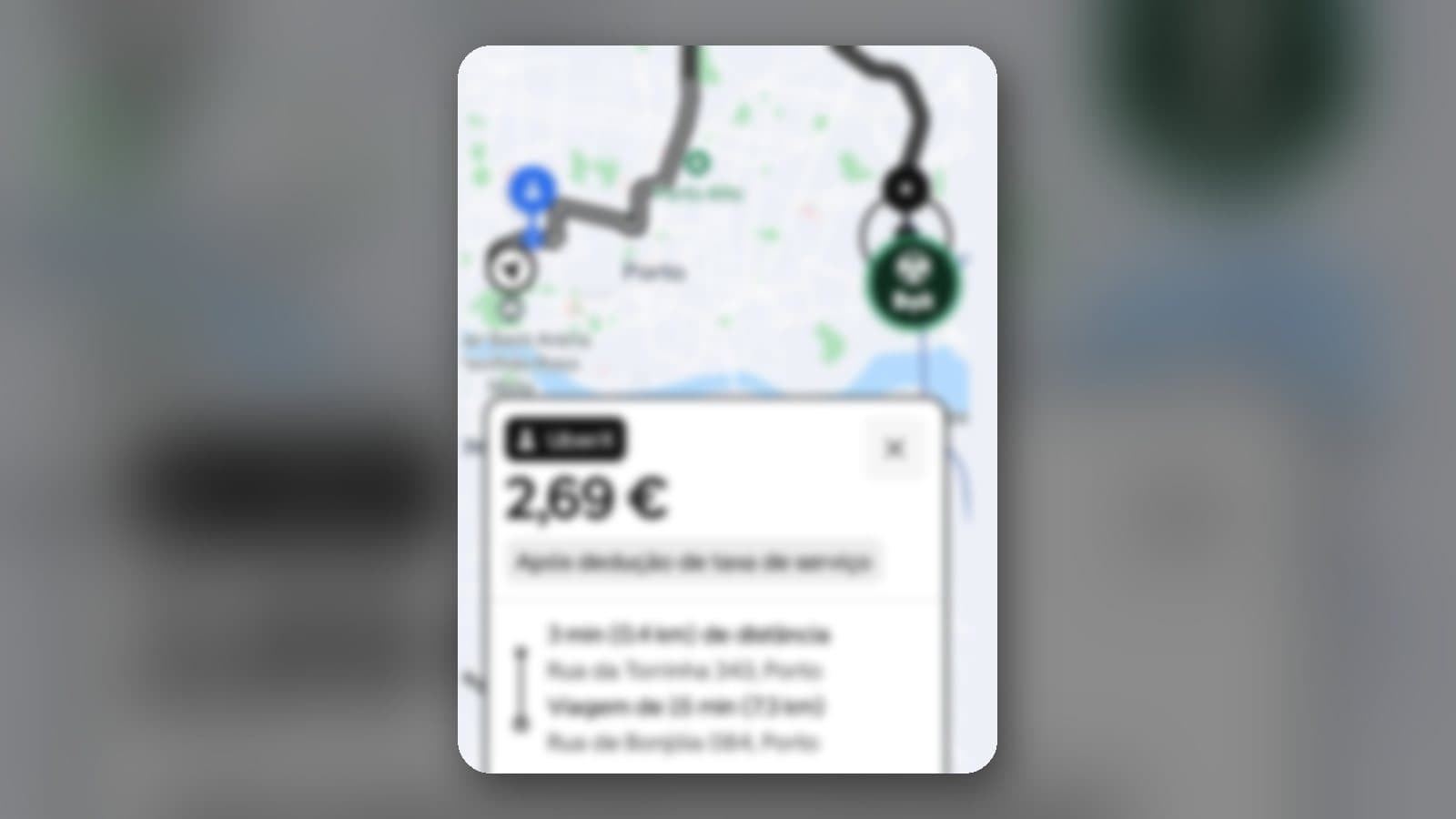
An 11.9 km ride for €4.68. Another where you drive almost 5 km, between pickup and trip, to receive €1.97. Both showed up as "Exclusive" in the Uber app, and both lose money for whoever accepts them.
You have a few seconds to decide on each offer, and new drivers tend to accept everything so they aren't left waiting. In this guide we explain what each km you drive costs, how to work out your minimum value per km, per minute and per hour, and we give you an easy-to-remember table, a ride map and a simulator to test any offer.
Why you shouldn't accept every ride
These are the two real cases we use as examples throughout the article:
- Ride A, Porto → Gondomar: €4.68 for an 11.9 km, 14-minute trip, with the passenger 1 minute away. That's around €0.39 per km. And the destination leaves you far from the busiest area.
- Ride B, Vila Nova de Famalicão: €1.97 for 1.6 km to the passenger plus a 3.3 km trip. Uber itself shows the estimate: €0.40 per km.
Each of these rides takes 11 to 15 minutes of your time, uses energy, tyres and car value, and in the end leaves you less than a coffee for every 10 minutes of work. Accepting this kind of offer isn't "earning little": often it's paying to work.
What has already been taken off the ride value, and what still has to come out
Before comparing values, it's worth understanding where the number on the screen starts from. The platform has already taken its share, but several outflows are still to come:
- Already taken off: Uber's or Bolt's service fee (commission).
- 6% VAT: ride values include VAT, which has to be paid to the State. Out of every €10, around €0.57 is VAT.
- Car costs: energy, maintenance, tyres and depreciation, which grow with every km.
- Fixed costs: TVDE insurance, the operator's fee, phone and data, which you pay even on days you drive little.
- Your personal taxes: income tax (IRS) and Segurança Social on what you earn. They're left out of this guide's maths, but don't forget them.
How much each km you drive costs
The first number you need is your cost per km. We split it into two parts: what varies with driving and the fixed costs the car has every month.
Variable costs per km
- Energy: in an electric car, charging at home and at public stations, count on around €0.05/km. In a combustion car using 6 litres per 100 km, it's around €0.10/km.
- Maintenance, tyres and car washes: around €0.03/km for an electric car and €0.05/km for combustion, which has more parts that wear out.
- Depreciation: a €24,000 car that loses most of its value over 300,000 km costs around €0.07 per km, even if you don't see that money leave your account.
Fixed costs, converted into km
TVDE insurance (around €200), the operator's fee (around €130) and phone, data and other costs (around €50) add up to close to €380 per month. Spread over 4,000 km driven per month, that's another €0.10 or so per km. Insurance alone is the car's biggest fixed cost.
All in, each km costs you around €0.25 in an electric car and €0.32 in a combustion car. If your car's energy costs more, read our article on rising fuel prices and switching to electric.
From cost to minimum value: the reasoning
Covering your costs isn't enough, you need to earn something for your time. The reasoning has five steps:
- Cost per km: €0.25 for an electric car, as we saw above.
- How much you want to earn per online hour: the reasonable floor is close to the minimum wage, around €6 per hour. A good target to start with is €12 per hour.
- Time without a passenger: not all online time is paid. Between waiting and repositioning, count on 60% of the time with a passenger or on the way to one. To earn €6 per online hour, each hour of rides has to leave you €10.
- Convert into km: at an average of 30 km/h, each hour of rides is 30 km. Those €10 come to €0.33 per km. Added to the car's cost, that's €0.58 per km.
- Add VAT: €0.58 × 1.06 gives around €0.62 per km.
Doing the same maths for the €12-per-hour target, you get around €0.97 per km. In a combustion car, both values rise to around €0.69 and €1.05. Choose the vehicle type in the chart below to see what each value is made of.
Where the minimum value per km comes from
Every km you drive has a cost. The ride has to pay that cost, your hourly earnings (counting the time without a passenger) and the 6% VAT.
- Car costs
- Your earnings
- VAT (6%)
Car costs €0.25 · Your earnings €0.33 · VAT (6%) €0.03
Car costs €0.25 · Your earnings €0.67 · VAT (6%) €0.05
Cost per km driven (Electric)
- Energy (electricity or fuel)
- €0.05/km
- Maintenance, tyres and car washes
- €0.03/km
- Car depreciation
- €0.07/km
- Fixed costs (insurance, operator, phone) spread over the km
- €0.10/km
- Total
- €0.25/km
Assumptions: 30 km/h average speed and 60% of online time with a passenger or on the way to one. Fixed costs of €380/month (€200 TVDE insurance) spread over 4,000 km/month.
Quick table: how much a ride should pay
Rounding the numbers above, we get an easy rule to remember: €0.60 per km is the floor, €1 per km is the target. Or, put another way: €6 for every 10 km is the minimum, €10 for every 10 km is a good ride.
Always count the total km, to the passenger plus the trip:
| Total km | Typical time | Decline below | Accept from |
|---|---|---|---|
| 3 km | 6 min | €1.80 | €3.00 |
| 5 km | 10 min | €3.00 | €5.00 |
| 8 km | 16 min | €4.80 | €8.00 |
| 10 km | 20 min | €6.00 | €10.00 |
| 15 km | 30 min | €9.00 | €15.00 |
| 20 km | 40 min | €12.00 | €20.00 |
Between the two values, the ride pays your costs and some earnings, but falls short of the target. That's where the other criteria, explained further down, decide.
Value per km, per minute or per hour?
In traffic, a short ride can take a long time. So look at the time too. These are four ways of measuring the same thing, with the equivalent values for an electric car:
| Metric | How to calculate | Floor | Good |
|---|---|---|---|
| Value per km | Value ÷ total km | €0.60 | €1.00 |
| Value per minute | Value ÷ total minutes | €0.30 | €0.50 |
| Value per driving hour | Value per minute × 60 | €18 | €30 |
| Net earnings per online hour | After VAT, costs and waiting time | €6 | €12 |
The practical rule: the ride has to pass both the km test and the minutes test. The km protect you on fast motorway trips, the minutes protect you in traffic. In a combustion car, raise the floor to around €0.70 per km.
The examples, step by step
Applying the rule to the three rides we use in the simulator:
| Ride | Value | Total km | Minutes | €/km | €/min | Decision |
|---|---|---|---|---|---|---|
| A: Porto → Gondomar | €4.68 | 11.9 | 15 | €0.39 | €0.31 | Decline |
| B: Famalicão | €1.97 | 4.9 | 11 | €0.40 | €0.18 | Decline |
| C: A good ride | €12.50 | 11 | 21 | €1.14 | €0.60 | Accept |
Ride A just about passes the minutes test, because the motorway is fast, but fails the km test: for 11.9 km it should pay at least €7.14. Ride B fails both.
Ride map: where each offer lands
The chart below places offers on a map: total km on the horizontal axis, the value shown on the vertical one. The two lines are the floor and the target. Hover to see the values for any distance.
Ride map: where each offer lands
Each dot is an offer: total km (pickup + trip) and the value shown. Below the red line you are paying to work; above the green one, the ride is worth it. Hover over the chart to see the values.
- Decline
- It depends
- Accept
For 10 km: floor €6.18 · target €9.72
- A: Porto → Gondomar: 11.9 km, €4.68 (Decline)
- B: Vila Nova de Famalicão: 4.9 km, €1.97 (Decline)
- C: A good ride: 11 km, €12.50 (Accept)
Assumptions: 30 km/h average speed and 60% of online time with a passenger or on the way to one. Fixed costs of €380/month (€200 TVDE insurance) spread over 4,000 km/month.
Simulator: should I accept this ride?
The table is for deciding in seconds. To fine-tune your limits, use the simulator: pick an example or enter the details of a real offer, and adjust your car's cost per km, your hourly target and the share of time you usually spend with a passenger.
Simulator: should I accept this ride?
Copy the details of the offer shown in the app. The simulator counts the km and minutes to the passenger, takes off VAT and the car's cost, and works out how much you earn per online hour.
Value per km (total)
€0.39/km
11.9 km
Value per minute (total)
€0.31/min
15 min
Ride profit
€1.44
after VAT and the car's cost
Earnings per online hour
€3.46/h
counting the waiting time
Decline: doesn't even reach the floor
To be worth it, this ride should pay at least €5.80 and around €8.45 to reach your target.
On ride A, after VAT and the car's cost, around €1.40 is left, less than €3.50 per online hour. On ride B just over 60 cents is left, around €2 per hour. Switch to combustion and watch the numbers get worse.
Other criteria besides value per km
Value per km is the main filter, but not the only one. When an offer sits between the floor and the target, these criteria help you decide:
- Destination: a ride that ends in an area with little demand forces you to drive back empty. On ride A, the return from Gondomar to central Porto can easily add 10 km without a passenger.
- Distance to the passenger: more than 3 to 4 km of pickup ruins almost any short ride, because that drive isn't paid.
- Time and area: at peak hours, declining a weak ride costs little, because another one arrives quickly. See the busiest hours in Portugal.
- Surge pricing, tips and promotions: they can make a ride acceptable, but only count on the guaranteed value shown in the offer.
- A second platform switched on: working with Uber and Bolt at the same time gives you more offers to compare and makes it easier to decline the bad ones.
- Platform rules: declining many offers can have consequences in some programmes or priorities. Check the current rules in the app before setting your strategy.
Common mistakes when you're starting out
In our experience with new drivers, these are the slips that weigh most at the end of the month:
- Looking only at the ride value, without dividing it by the km and minutes.
- Forgetting the km to the passenger.
- Not counting VAT and fixed costs, and thinking the value shown is profit.
- Choosing a car that uses a lot: in a combustion car, the floor per km rises by around €0.07. If you're still choosing, it's worth looking at used cars already prepared for TVDE.
- Not recording each day's km and earnings, which makes it impossible to know your real cost per km.
Pronto para começar?
A Arterian oferece o slot TVDE completo por apenas 30€/semana. Ativação em cerca de 48 horas, sem fidelização e suporte 24/7.
Get Your Slot for €30/weekSet your number before switching on the app
Deciding in seconds is easy when you've already done the maths at home. Work out your cost per km, choose your hourly target and memorise two numbers: the floor and the target per km. From then on, every offer is mental arithmetic, not a guess.
If you'd like help working out your numbers or understanding whether your car pays off, get in touch. We'll explain, with no commitment, how we work with the drivers in our fleet.
Not sure which rides to accept? Get in touch with us on WhatsApp or send us an email.